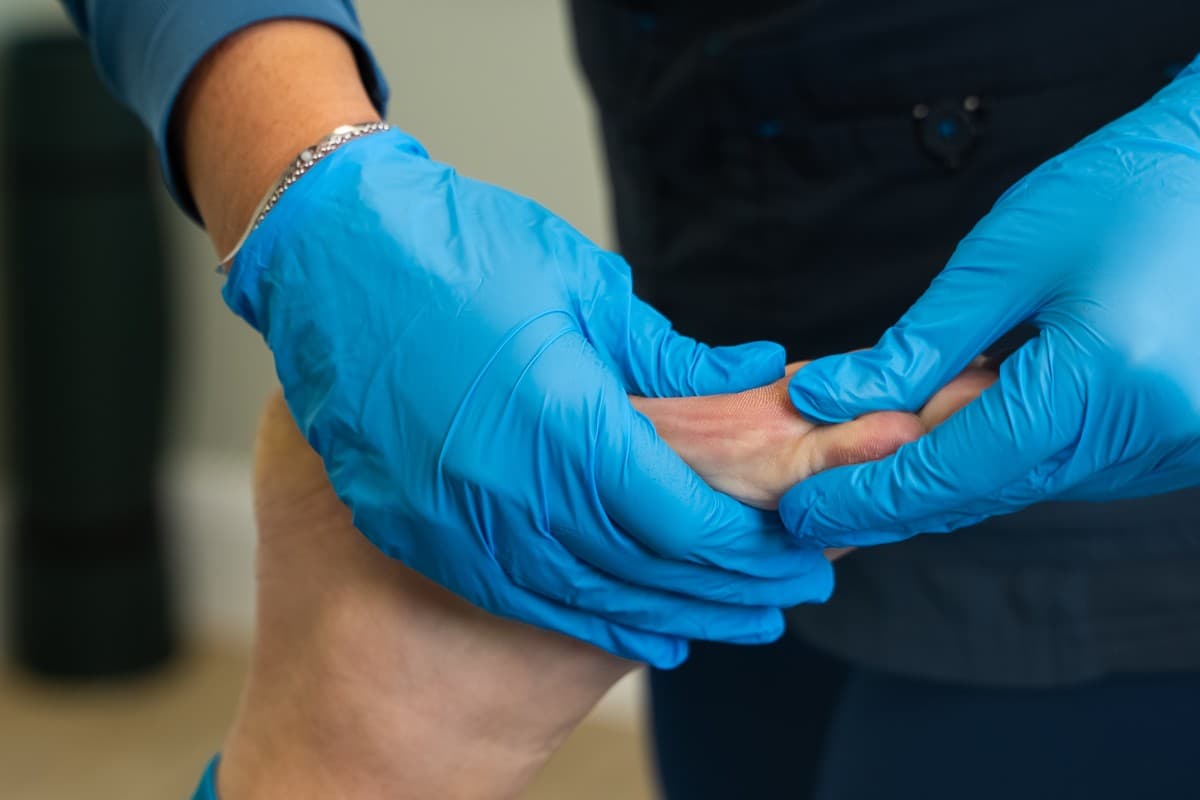



Almost everyone who comes to us with plantar fasciitis has already been stretching. Calf stretches against a wall, rolling the arch on a frozen bottle, pulling the toes back before getting out of bed. Most have been doing it diligently for months.
Stretching is not wrong. It is just not sufficient, and understanding why explains most of what goes wrong in plantar fasciitis treatment.
What stretching actually does
Stretching temporarily increases tissue length and reduces the pull on the fascia. It genuinely helps in the short term, particularly before those first steps in the morning.
But it addresses a symptom of the problem rather than the problem. Plantar fasciitis is fundamentally a capacity issue: the tissue is being asked to handle more load than it can currently tolerate. Making it slightly longer does not make it stronger.
The stage almost everyone stops at
Recovery from plantar fasciitis has two distinct halves.
The first half is settling the pain. Rest, ice, stretching, off-the-shelf insoles, sometimes an injection. This works, often quite well. Pain drops, walking becomes tolerable, life resumes.
At this point most people stop, because the thing that was bothering them has stopped bothering them. This is completely reasonable and it is why the problem comes back.
The second half is rebuilding the tissue's capacity so it can handle normal life without failing again. This takes longer, feels less dramatic, and requires doing specific work when you are no longer in much pain - which is exactly when motivation drops.
What progressive loading means in practice
Loading the plantar fascia and the calf complex means graded strength work, increased in a controlled way as the tissue tolerates it. Too little and nothing changes. Too much too soon and you flare it.
Getting that progression right is most of the clinical skill involved. We monitor how your symptoms respond at each stage and adjust rather than handing you a fixed protocol printed off a sheet. Two people with the same diagnosis rarely progress at the same rate.
Where orthotics genuinely fit
Orthotics have a real role, and it is a narrower one than they are usually sold with.
A device that offloads the specific area under strain buys the tissue room to recover while you rebuild its strength. That is useful. What it does not do is fix the underlying weakness - which is why people who are given an insole and nothing else often find the pain returns when they stop wearing it.
We prescribe Phits 3D-printed orthotics manufactured from your own Gait and Motion Footscan pressure data, so the device is built around where your load actually goes. Where the assessment does not support an orthotic, we will tell you that rather than selling you one.
What else we can use
Class 4 laser therapy is used in the early phase to bring pain down and improve tissue tolerance. That matters more than it sounds: rehabilitation cannot start while a tissue is too painful to load, so anything that shortens that waiting period brings the real work forward.
For pain with a nerve component that has not responded to conventional treatment, we can offer pulsed radiofrequency neuromodulation. Foot Focus is currently the only podiatry clinic in Ireland offering it.
How long it takes
Longer than people want to hear, and the honest answer depends on how long it has been going on, how much capacity has been lost, and what you need to get back to.
What we can say plainly is that the timeline is driven by the loading stage, not the pain-relief stage. Anyone promising you a fixed number of weeks before they have assessed you is guessing.
If you have been stretching for months and it keeps coming back, the missing piece is almost certainly the part that comes after the pain settles. You can book directly at Finglas or Mount Merrion without a GP referral.
This article is general information about a common foot condition and is not a diagnosis or a treatment plan for any individual. Foot pain has several possible causes that present similarly, so if something is troubling you, have it assessed in person.
References
- Plantar fasciitis - HSE (Health Service Executive, Ireland)
- Plantar fasciitis - NHS
- Heel pain - HSE (Health Service Executive, Ireland)
This page is for general information and does not replace individual clinical assessment. If symptoms persist, book an appointment with a CORU-registered podiatrist.